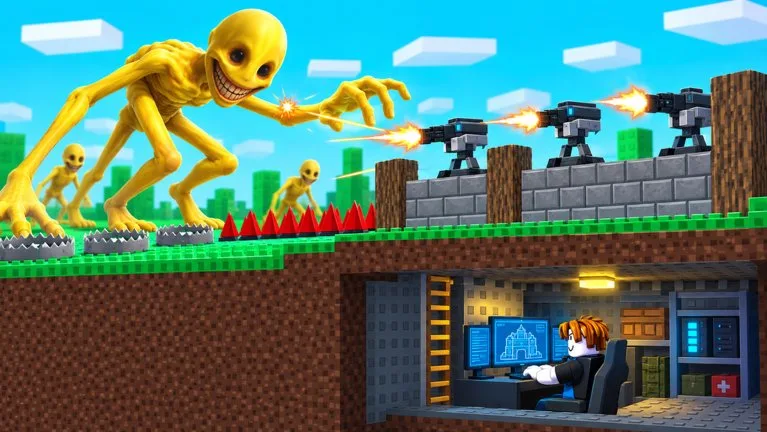
The useful core is the same in every long run: one protected entrance, clear firing lanes, a path through the interior, and a fallback for repairs. Player count and how long you plan to stay change the shell around that core. Server size is documented at up to six players. Nothing on record says a larger team gets a bigger plot.
Compact core
- Choose the spot before you place anything. You want sightlines to the entrance and room to expand. Avoid ground that lets Verities walk in behind the guns.
- Place main walls and the entrance. Keep the interior compact.
- Cover the approach, not an isolated corner.
- Cross two turret arcs at the entrance. If both guns watch one lane and another approach is empty, move one.
- Leave a fallback inside the first layer.
- Keep enough coins for one emergency repair.
A 30-second check before the wave: angles clear of walls, props, and teammates; paths open; no missing wall section. During the wave, the layout is working if turrets can fire along the approach, not only at the door.
Four shells
| Layout | Use it when | Core | Weakness |
|---|---|---|---|
| Compact solo | Solo or the first nights | Small room, one entrance, short walls | A blocked angle is expensive |
| Cooperative crossfire | Two or more players | Central room, two overlapping lanes | Crowding cuts visibility |
| Long-wave reinforced | Deep runs | Primary line, interior route, fallback | Slow and costly while unfinished |
| Hidden defense | You need the guns protected | Turrets behind strong sections, arcs still open | Too much cover creates blind spots |
Under sustained giant-Verity pressure, the long-wave shell fits better because the fallback and the reserve are already part of the plan. Upgrade the sections that are actually hit. One reinforced entrance beats five half-built walls.
Glass front or reinforced line
A glass or low-HP front gives full sightlines and cheap early coverage, and it needs repairs during the wave. A reinforced line absorbs hits and is mostly repaired between waves, at a higher upfront cost. The combination that shows up in longer runs is a transparent front with a reinforced fallback behind it. A solo player cannot repair and shoot at the same time, so build that fallback earlier and keep a larger reserve.
Glass in footage is often used for looks and for sealing gaps. There is no test that measures how much protection a transparent section gives up. Read the HP label in the palette.
What four recorded runs actually got hit by
- One-direction wall, three shotgun turrets at the door, spikes and an electric floor, reached wave 18. At wave 10 enemies also came from the side. Explosive Verities broke blocks.
- Verity-block perimeter with two doors and a front turret mass, reached the wave 90s. Pressure stayed on the front in that run, so the back was never tested.
- Underground room with a turret ring, spikes, TNT, and an electric floor, reached wave 26. Verities dug in. Some TNT never detonated.
- Roof turrets with the top closed. Enemies later came from behind, and a late wave broke the bunker door.
Three of those four runs were hit somewhere other than the planned front. Treat "they only come from the front" as something you verify, not a plan.
Who does what
| Team | Split |
|---|---|
| 2 players | One builds and repairs. One holds the best firing spot. |
| 3 players | Builder, gunner, and a scout who calls the lane early. |
| 4 or more | Fixed turret operators, one repair player, one flexible responder, one person watching the coin reserve. |
| Any size | Someone confirms repairs, staffing, and the reserve before the wave. |
Callouts that help name the lane, the repair, and how urgent it is.